

A solar panel alone isn’t a complete home power system. It converts sunlight into electricity, while an inverter and, when needed, batteries help supply power to household appliances. Choosing solar panels for a home in Nigeria starts with matching panel output and system size to the appliances you need to run.
Look beyond the panels themselves. Panel type, battery capacity, system design and installation all affect performance and total cost. The price depends on the project, including system size, battery capacity and installation requirements, and is provided after a quote request.
This guide explains panel wattage and common panel types, then covers installation costs and bundle pricing. It also looks at solar’s environmental benefits, helping you compare options and identify what your home needs without treating panel wattage as the whole answer.
Key Takeaways
- Match panel wattage to the appliances you need to run; panel output alone doesn’t determine the capacity of a complete home system.
- Compare panel types by efficiency and installation conditions. Monocrystalline panels are described as having 20-22% efficiency, while bifacial panels can use light reaching both sides.
- Account for batteries when planning your installation: they can represent 40-60% of a solar system’s total cost in Nigeria.
- Compare multi-panel bundles by total wattage and panel type, not just the number of units or headline price.
- A 5 kW solar system is stated to offset 5-10 tons of CO2 annually, making environmental impact another factor to weigh alongside household power needs.
Panel wattage options
Panel wattage is its rated power under test conditions. It helps estimate the size of an array, but does not show how much energy a household uses. Choosing solar panels for a home in Nigeria means comparing panel output with appliance demand, sunlight and the other system components.
Panel wattage ratings vary, so compare specifications when choosing a system. Panels in the 400-watt range are another option. Many have an open-circuit voltage of 38 volts or higher. Some reach close to 70 volts, so voltage compatibility matters when panels connect to system equipment.
Consider a 400-watt panel example. Its maximum-power-point voltage is 37.2 volts, and its maximum-power-point current is 10.76 amperes. Multiply those values to get 400.272 watts at the maximum power point. This shows why panel specifications matter alongside the wattage label.
A charge controller also affects usable output. In the stated example, a PWM controller can provide 30% less power per day than an MPPT controller under the best conditions. The 400-watt panel’s maximum output with PWM is 156.2 watts. For this example, a 40-amp-or-higher MPPT controller is recommended, rather than a 30-amp controller. Match controller capacity and panel voltage to the system.
What solar system size does a Nigerian home need for its appliances and daily energy use? List each appliance, its wattage, and daily operating hours. A 1 kW system is an example for a rural home with basic lighting needs. A 5 kW system is an example for a household with heavy appliance usage.
How much can a home solar system save compared with a generator and grid electricity in Nigeria? Savings depend on how much solar power replaces generator fuel or grid electricity. Compare your current energy spending with the electricity the system can supply.
Which solar panel and inverter brands are reliable and available in Nigeria? Listings include LONGI and Jinko panels, as well as SolariQ hybrid inverter packages. Compare model specifications and warranty terms, since a brand name alone does not establish whether equipment suits your system.
What maintenance, lifespan, and warranty should homeowners expect from solar panels and batteries? Check batteries monthly and arrange annual inspections by certified technicians. Jinko’s 440W Monofacial panel has a 10-year warranty. Its 485W Tiger Neo panel has a 30-year linear power warranty and 0.4% annual degradation over 30 years.
What risks should Nigerian homeowners watch for when buying or installing solar systems? Check that panel voltage and controller capacity match, and size the system for daily demand. A nominal 12-volt, 200-amp-hour lead-acid battery provides about half its labelled capacity for use. One example gives 1060 watt-hours available against daily use of 1200 watt-hours.
System ownership and buyout options depend on the agreement. Before signing, clarify who owns the panels and batteries, whether a buyout is available, and what it covers. Keep ownership terms, installation details and warranty documents in writing.
Bifacial and monocrystalline panel types
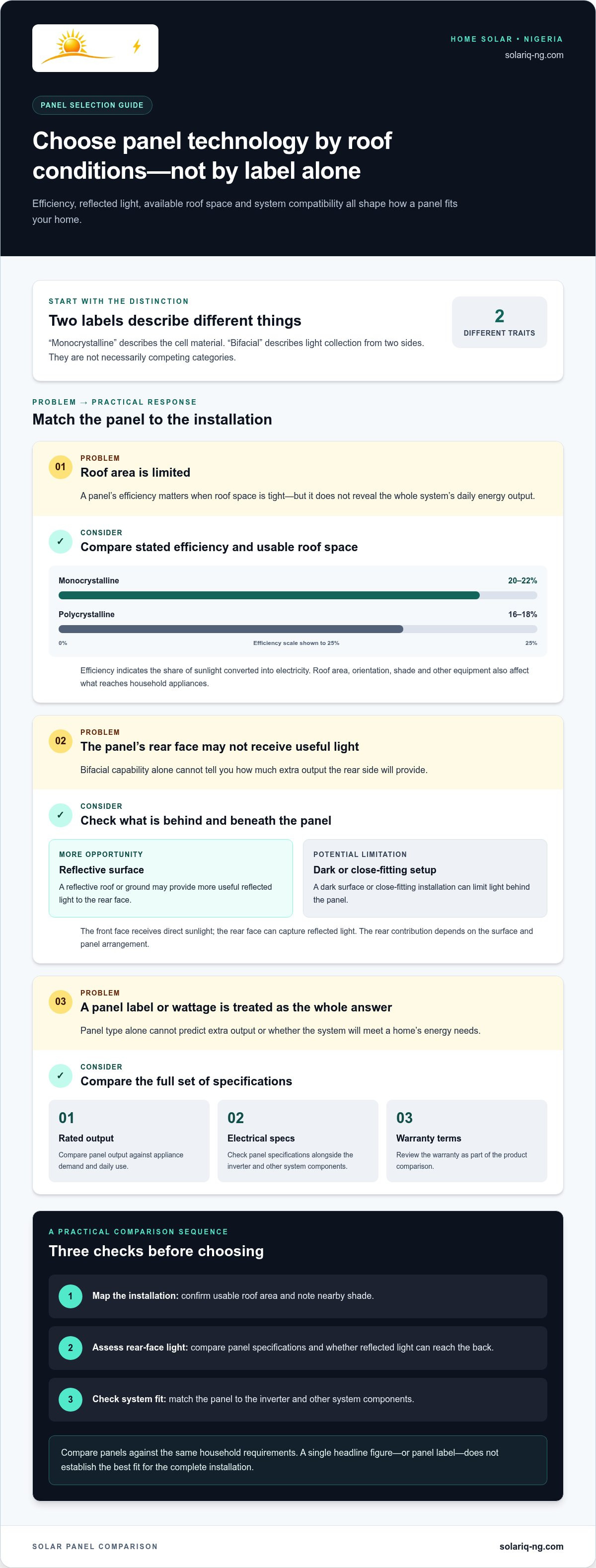
Monocrystalline describes a panel made with single-crystal silicon cells. Its stated efficiency range is 20-22%. Polycrystalline panels are described at 16-18% efficiency. Efficiency helps compare how much sunlight panels convert into electricity. It does not tell you the full system’s daily energy output. Roof space, panel orientation, shade, and equipment also affect what reaches household appliances.
Bifacial panels can collect light from both faces. The front receives direct sunlight, while the rear can capture reflected light. How much the rear contributes depends on the surface and panel arrangement. A reflective roof or ground may provide more useful reflected light than a dark surface, while close-fitting installation can limit light behind the panel. Panel type alone cannot predict the extra output.
For a Nigerian home, compare installation conditions before choosing. Note the usable roof space, nearby shade and surface beneath the proposed panels. Then consider whether the rear face can receive reflected light. If the surface blocks light, bifacial capability may add little practical value. A monocrystalline panel may be easier to compare when only the front face receives sunlight.
Efficiency can matter when roof area is limited. A panel with higher stated efficiency can convert a larger share of the sunlight reaching it. Household sizing still depends on appliance demand and daily use, so compare panels against the same system requirements, not efficiency alone. Check rated output, electrical specifications, installation fit and warranty terms together. These details make comparisons more useful than a single headline figure.
Use a simple comparison process. First, confirm usable roof area and note any shade. Next, compare monocrystalline and bifacial panel specifications, including whether the rear face can receive reflected light. Finally, match the panel to the inverter and other system components. This keeps panel technology connected to the complete installation rather than treating it as a stand-alone upgrade.
Panel labels also need careful reading. “Bifacial” describes light collection from two sides; “monocrystalline” describes the cell material. These terms can describe different aspects of a panel, so they are not always opposing categories. Compare the actual product specifications rather than assuming one label answers every question. You can compare solar panel options against your roof layout and household needs.
These listings are product examples, not a like-for-like measure of value: the LONGI listing is for a panel, while the Jinko listings are combo listings. Compare wattage, panel description, quantity and listed amount, and confirm what each seller includes before buying. Price alone does not establish expected household output or suitability. Roof conditions and system requirements still matter.
Environmental benefits of solar power
A 5 kW solar system is stated to offset 5-10 tons of CO2 annually. Treat this as an example, not a fixed result for every Nigerian home. The effect depends on how much solar electricity replaces power from other sources. A system used during the day can offset more grid or generator electricity when household demand matches its output. Energy still supplied by other sources reduces the overall benefit.
Solar power can reduce reliance on fuel generators. When solar runs appliances that would otherwise use generator power, the household burns less fuel for those tasks. This can also reduce generator exhaust and operating noise at home. The environmental benefit depends on actual use, not panel capacity alone. Track which appliances run on solar and when to understand what the system replaces.
Grid-tied, off-grid and hybrid systems suit different needs. A grid-tied system works alongside utility power, while an off-grid system operates without a grid connection. A hybrid arrangement combines solar with another power source and batteries. Is solar, grid-tied, off-grid or hybrid power best for a Nigerian home? Choose grid-tied if grid access is available and backup is not the priority; choose off-grid for a home without grid access. A hybrid system suits households seeking solar alongside grid power and battery backup.
Environmental benefits also depend on how well the system fits daily demand. First, list appliances and their usual operating times. Identify which loads can run during sunlight hours, then size the system around those needs rather than installing unused capacity. For example, daytime water pumping can use solar electricity directly, while night-time lighting needs stored energy or another supply.
What permits, regulations or approvals are required to install home solar in Nigeria? Requirements depend on the system connection and installation location. Establish whether the system connects to the grid or operates independently, then identify the applicable local approval process before work begins.
Battery choice affects backup and environmental performance. A battery can store daytime solar power for evening use, but its capacity must match the loads and backup period. How many batteries are needed to power a home overnight or during outages in Nigeria? Calculate appliance energy use over the backup period, then match that demand to usable battery capacity and the system design.
Installation choices can reduce avoidable waste. Keep panels clear of regular shade and use the electricity they generate. Good system sizing helps avoid equipment that sits unused or batteries that repeatedly fall short. Maintenance matters too: a poorly maintained system may not deliver the expected power, increasing reliance on grid electricity or generators.
Use three checks to weigh the environmental case: estimate which power source solar will replace, match generation to household use, and include battery storage needs. The 5 kW example provides a useful reference point, but each home’s result depends on its usage and system setup. Focus on electricity actually supplied by solar, not the panel rating alone.
Factors affecting installation costs
Solar installation costs depend on the system each home needs. In Nigeria, key factors include energy demand, battery capacity, panel quantity, inverter capacity and site work. A household running lights and fans needs a different setup from one adding refrigeration or water pumping. Equipment must match the appliances and the hours they run.
Start with a load list. Record each appliance, its wattage and daily use, then separate essential loads from those used occasionally. This helps define system size without paying for capacity the household will not use. It also shows whether the system must support daytime use, overnight use or both.
Battery capacity is a major cost driver. Solar batteries can account for 40-60% of a solar system’s total cost in Nigeria. The required capacity depends on which appliances need backup and how long they must run without sunlight. More stored energy usually means a larger battery investment. Prioritise essential evening loads before sizing storage for every appliance.
Panel quantity and inverter capacity also affect the total. Higher energy demand or battery charging needs may require more panels. The inverter must support the appliances expected to run at the same time. A home operating a refrigerator and several other appliances needs a different capacity plan from one powering lights alone. The design must account for both running loads and starting demand.
Installation conditions can change the work involved. Roof space, shade, panel placement, cable routes and equipment location all shape the layout. A difficult route between panels, batteries and the inverter can require more materials and labour. The installation must also account for mounting and safe connections. These details vary by property.
- Energy use: appliance wattage and operating hours determine required generation.
- Backup needs: essential loads and outage duration guide battery capacity.
- Site work: roof layout, shade, and cable routes affect installation requirements.
Compare quotes against the same scope. Check the panels, inverter, batteries, accessories, installation work and after-sales servicing included. A lower total may reflect a smaller system or different equipment, not the same setup at a better rate. Review the components and work included before comparing totals.
The price depends on the project, including system size, battery capacity, equipment selection and installation requirements, and is provided after a quote request. A clear load list and property layout help define what is needed. Note which appliances must remain available overnight and which can operate during daylight. This gives the system design a practical starting point.
Multi-unit panel bundle prices and discounts
A multi-unit bundle groups panels for a larger installation. In Nigeria, listed Jinko examples include 50 bifacial N-Type panels rated at 585W each, and bundles of 25 or 50 rated at 720W each. These quantities suit projects needing multiple panels, but bundle size alone doesn’t show whether the system fits your home.
Compare total rated output before considering a bundle’s value. Fifty 585W panels provide 29,250W of combined rated capacity. Fifty 720W panels provide 36,000W. A 25-panel, 720W bundle provides 18,000W. These totals help compare the listed configurations, but they don’t predict daily generation or determine what your household needs.
A discount matters only if the panels suit the project. Compare the bundle’s panel count and wattage with your intended array, then check panel type, electrical specifications and compatibility with the system design. A larger bundle can leave you with excess capacity if your roof, inverter or household demand cannot use it. Choose for the installation, not the headline offer.
- 50 × 585W: Jinko bifacial N-Type panels, 29,250W combined rated capacity.
- 25 × 720W: Jinko bifacial N-Type panels, 18,000W combined rated capacity.
- 50 × 720W: Jinko bifacial N-Type panels, 36,000W combined rated capacity.
To judge a bundle discount, compare its total panel cost with the equivalent individual-panel purchase. Make sure you are comparing the same model and quantity. A lower total may reflect different wattage or panel type rather than a discount on an identical set. Check what the bundle includes, and separate panel costs from delivery, mounting, wiring and installation charges.
For household planning, convert the bundle’s rated capacity into a practical system design. Count available roof space, account for shade, and identify the inverter specifications. Then match the array to daily appliance use and battery charging needs. A 50-panel purchase may suit a larger project, while a smaller installation may need fewer panels. The right amount depends on the intended system.
Bundle listings can change, so compare the current terms for the same model and quantity. Check whether warranty coverage applies to each panel, and keep purchase details together. Include installation and compatible system components in your overall comparison. Panel-only bundles do not represent the complete cost of a functioning solar setup.
Planning a multi-panel installation? Explore solar panel options and compare them with your project’s capacity, roof space, and system design.
SolariQ: Hybrid inverters
SolariQ offers hybrid inverters for homes combining solar power with battery storage and another available power source. A hybrid inverter manages how these sources supply compatible household loads. Its capacity and compatibility must match the panels, batteries and appliances in the system.
Consider a hybrid inverter if you want to use solar power while keeping another supply available, or store solar energy for later use. Start by listing the appliances you need to run and when you use them. This helps shape a system around your daily routine instead of choosing an inverter by its label alone.
For help choosing a hybrid inverter for your home, contact SolariQ.
Plan your next step with confidence
Before choosing a system, decide what the first stage needs to power. Separate essential needs from appliances you may add later. This gives your design a clear starting point and helps plan future changes without treating every appliance as an immediate requirement. Choosing solar panels for a home in Nigeria is easier when your priorities are clear, not just your equipment list.
SolariQ offers solar panels, hybrid inverters and solar accessories. These components can be considered together as part of a home solar setup. Bring your appliance priorities and future plans into the conversation. Note which loads matter most, when you use them and what you may want to add. This keeps the discussion centred on system fit rather than a specification that looks good on paper.
Contact SolariQ for solar panel advice and take a practical next step for your home.
Frequently Asked Questions
What Are Solar Panels?
Solar panels use photovoltaic cells to convert sunlight into direct-current electricity. A home system uses an inverter to convert that electricity into a form household appliances can use. Panels are one part of the setup: mounting, wiring and compatible electrical equipment connect their output to the home. For example, an array can supply an inverter, which then serves selected household circuits.
What is the installation process and typical labor cost for home solar in Nigeria?
Installation labour costs depend on system design, roof layout, wiring route and site work. SolariQ provides pricing after a quote request. The process starts by assessing power needs and the property, then designing the system and installing and connecting the equipment. The final step is testing the setup and explaining how it operates. SolariQ designs and installs solar systems for homes, tailoring the work to power needs, outage duration and roof conditions.

