

A higher kVA rating doesn’t automatically mean a better backup system. If you’re searching “buy hybrid inverter Nigeria,” start with the appliances you need to run and how long outages usually last, not the biggest number on the label.
It’s reasonable to want dependable power without spending on a system that can’t handle your daily load. But kVA is only one part of the decision. Appliance demand, startup surges, battery capacity, solar panel compatibility, and roof conditions all affect how a system performs. A mismatch can leave you short of power or paying for capacity you don’t need.
This guide explains how to compare hybrid inverters against your actual power needs, solar setup, and outage patterns. You’ll learn which compatibility details matter and what to consider when planning system design, installation, warranty, and after-sales support. SolariQ designs and installs solar systems around each project’s requirements, and states that its products and services are covered by a five-year warranty. The aim is to help you choose with less guesswork and more confidence.
Key Takeaways
- Before you buy a hybrid inverter in Nigeria, list the essential appliances you need to run and when you need them.
- Size the inverter using appliance running demand and startup needs, then compare those figures with the model’s stated output and surge capacity.
- Match the inverter’s battery voltage, charging options, and solar input with your planned battery and panel setup.
- Compare complete offers, including model details, installation scope, documentation, and after-sales arrangements, rather than relying on a headline price.
- SolariQ brings inverter supply, system design, professional installation, and after-sales servicing together, with designs tailored to your needs and roof conditions.
Buying a hybrid inverter in Nigeria starts with the power problem you need to solve
During an outage, you may need the lights on, the fridge running, or essential business equipment powered. The challenge is choosing a system that can support those priorities for as long as you need, without paying for capacity you won’t use. A hybrid inverter manages power from compatible sources, such as solar panels, batteries, and the grid, according to the system design. For a simple explanation of inverter basics, see What is a Power Inverter?
Not every hybrid inverter suits every need. The right setup depends on the appliances you’ll run, how long outages typically affect you, and how the inverter works with the panels and batteries. Choosing an inverter is one decision; planning the full system is another. An inverter alone cannot promise uninterrupted power if the battery, solar input, or connected loads are not suited to the job.
What should a hybrid inverter do for your home or business?
Start with your routine, not a model name. List the appliances or equipment you need during an outage, then estimate how many hours you’ll use each one. Separate essentials from optional loads, such as an extra television or appliance you can switch off to extend backup time.
- Household priorities: Identify the equipment needed for everyday comfort and essential routines.
- Business priorities: List the equipment that supports work, customer service, or safe operations.
- Usage duration: Estimate how long each priority load needs to run during an outage.
A household may prioritise lights, refrigeration, and internet access. A small business may need lighting, computers, or specific work equipment. These are planning examples, not fixed load recommendations. Use the appliance labels and your actual usage patterns to guide the design.
Why the inverter rating alone cannot settle the decision
kVA is a rating, not a complete measure of whether an inverter suits your system. Appliances draw power while running, and some need a brief burst of extra power when they start. That starting demand can affect whether several appliances can operate together. Compare the inverter’s stated specifications with appliance information instead of assuming a rating will cover a particular set of equipment.
Quotable takeaway: Inverter capacity must match the combined demand and starting needs of the loads you plan to connect.
Before you buy a hybrid inverter in Nigeria, treat the rating as a starting point for comparison, not the whole answer. Note which devices may start at the same time, which can be switched off, and which must keep running. These details help determine inverter capacity and the battery and solar setup needed for your outage pattern.
SolariQ designs systems around power needs, outage duration, and roof conditions, then provides professional installation. That broader planning helps create a compatible setup for your priorities, rather than focusing only on a large number printed on the inverter.
How to size a hybrid inverter around your appliances and outage pattern
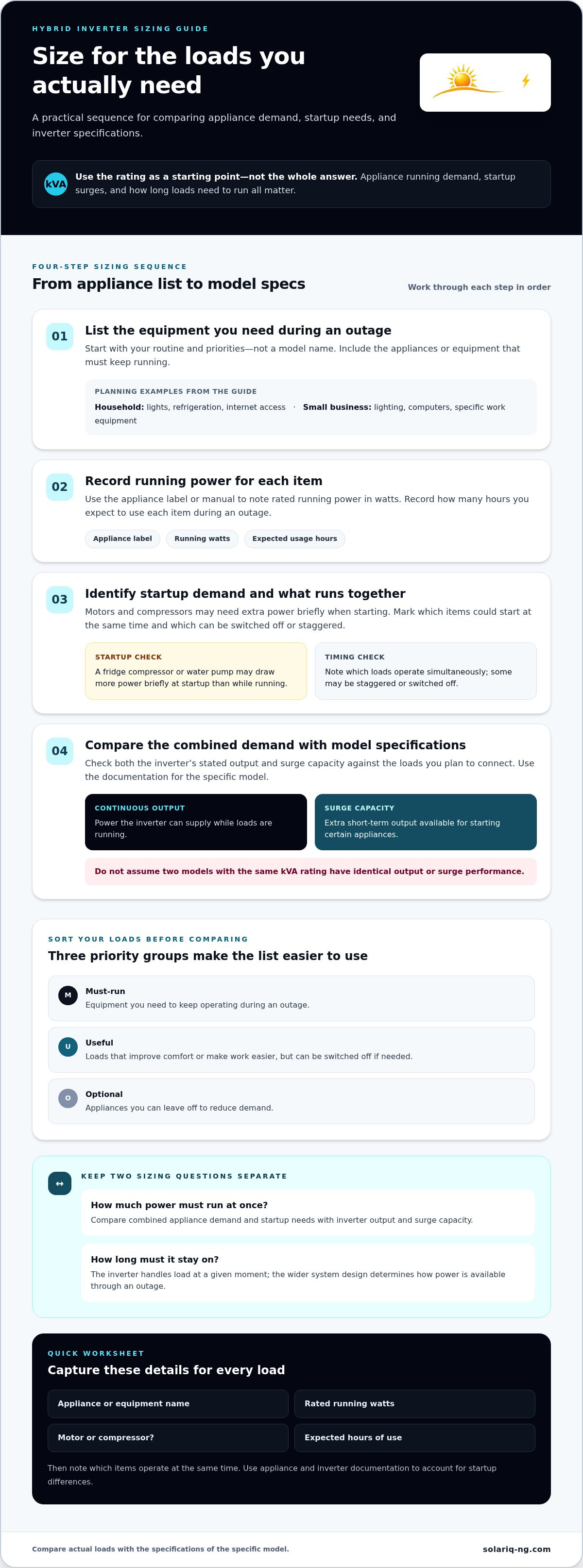
A useful sizing plan turns your appliance list into two separate questions: how much power must run at once, and how long must it stay on? Keep those answers distinct. The inverter handles the load at a given moment; the wider system design determines how power is available through an outage.
Use this sequence before comparing models:
- List the appliances and equipment you need during an outage.
- Record each item’s running power in watts from its label or manual.
- Identify equipment that may need extra power to start, such as motors and compressors.
- Decide which items may run together, then compare the combined demand and starting needs with the inverter’s stated specifications.
Build a realistic list of essential loads
Sort equipment into must-run, useful, and optional groups. Record the rated power for each appliance and mark which ones may start at the same time. A fridge compressor or water pump, for example, may draw more power briefly at startup than while running. Use the appliance and inverter documentation to account for that difference.
- Must-run: Equipment you need to keep operating during an outage.
- Useful: Loads that improve comfort or make work easier, but can be switched off if needed.
- Optional: Appliances you can leave off to reduce demand.
Simple worksheet: For each item, write its name, rated running watts, whether it has a motor or compressor, and the hours you expect to use it. Then note which items will operate at the same time. This gives you a practical list to compare with model specifications, without relying on a generic household size or guessed capacity.
Match inverter output to how long you need backup
Continuous output is the power an inverter can supply while loads are running. Surge capacity is the extra short-term output available for starting certain appliances. Check both figures in the specific model’s documentation. Don’t assume two models with the same kVA rating have identical output or surge performance.
Next, consider your schedule. If several essential appliances run together, their combined demand affects the inverter output you need. If you can stagger some loads, peak demand may be lower. The hours you want backup affect the wider design, especially the stored energy and solar input the system needs. They don’t change the inverter’s output rating.
Quotable takeaway: Inverter output describes how much load can run at once; backup duration describes how long the wider system can support it.
Keep the worksheet beside the model specifications as you compare options. For broader context on renewable energy in Nigeria, visit the Renewable Energy Association of Nigeria. For a complete system plan based on your power needs, see SolariQ’s system design and installation service.
Compare hybrid inverter specifications and check system compatibility
Two inverters with similar headline ratings can have different battery and solar requirements. Compare the full specification sheet with your planned components, not just the kVA figure. As you buy hybrid inverter Nigeria, use a side-by-side checklist to spot mismatches before installation.
| Specification | What to compare | Why it matters |
|---|---|---|
| Continuous output and surge capacity | Check both figures against the loads you expect to run together and their starting demand. | The inverter must handle normal operation and any short startup demand within its stated limits. |
| Battery voltage | Match the inverter’s required voltage to the planned battery bank configuration. | A voltage mismatch can prevent the components from working together as intended. |
| Charging specifications | Compare the inverter’s charging requirements and limits with the battery bank details. | Charging must suit the planned system, not an assumed or generic setup. |
| Solar input | Check the inverter’s solar input limits against the panel arrangement in the system design. | The panel configuration must stay within the model’s stated input range. |
| Installation requirements | Review the model’s instructions, connection needs, and space requirements. | Installation planning affects where and how the system can be fitted. |
Which inverter specifications matter before you buy?
Start with output. Compare continuous output and surge capacity with the appliance worksheet from the previous section. Then check battery voltage and charging specifications against the planned battery bank. Finally, review the solar input limits against the panel arrangement. Use the exact model documentation for each check. Don’t transfer a specification from one inverter to another, even if their ratings look similar.
How to check compatibility across the full system
Think of the inverter, batteries, and solar panels as connected parts of one system. Their specifications must align. For example, a panel plan that exceeds an inverter’s stated solar input limits is not a suitable match, even if the inverter output appears adequate for your appliances.
Quotable takeaway: System compatibility depends on matching the inverter, battery, and panel specifications as one design.
Also review the source-input options on the specific model. Grid or generator input belongs in the plan only where that inverter supports the configuration. Don’t assume every model accepts the same inputs or handles them in the same way. For background on Nigeria’s wider energy alternatives, see Solar Energy Adoption in Nigeria.
If you’re learning how the components work together, start with the basic sequence: identify the available power sources, understand how the chosen inverter manages them, then check how the connected battery and panels fit its specifications. SolariQ’s system design and installation bring those component checks into one plan, tailored to your power needs and roof conditions.
Use this buying checklist to compare inverter offers in Nigeria
A headline price or impressive rating can make an inverter offer look straightforward. But the figure alone doesn’t show which equipment, design work, installation, or support is included. Compare the written scope as carefully as the inverter itself. That gives you a clearer view of what the system is designed to do and what happens after installation.
Questions to resolve before choosing an inverter offer
Keep your appliance worksheet and system specifications together as you review an offer. The model details should match the intended design, and the written scope should make clear how the system will be installed and supported. Use this checklist to compare practical details, not just the headline figure.
- Complete model details: Record the inverter’s make and model, continuous output, surge capacity, battery voltage, charging specifications, and solar input limits. Compare these with your planned system.
- System components: Note which inverter, batteries, panels, and accessories are included in the proposed design. Separate included equipment from items listed as optional or outside the scope.
- Design and installation: Check that the scope covers system design and professional installation. The plan should reflect your power needs, expected outage duration, and roof conditions.
- Documentation: Keep the specification sheet, written offer, installation documents, and purchase records together. Clear records make it easier to refer back to what was supplied and installed.
- Warranty and after-sales support: Read the written warranty terms, including the stated coverage, exclusions, and claim process. Keep the after-sales servicing arrangements with your other system documents.
The lowest headline figure may cover only the inverter, while another offer may describe a broader system or include design and installation work. These are different scopes, so the figures are not a like-for-like comparison. Compare what each written offer includes before deciding what suits your requirements. A model name or rating alone does not show whether the full system is accounted for.
Plan the purchase around installation and future servicing
Include installation in the plan from the start. Consider inverter placement and leave room for service access. The system layout should also account for roof conditions and the planned positions of panels and other equipment. These details connect the purchase to how the system will be installed and maintained.
Store the final specifications, purchase records, installation documents, and warranty information together. If servicing is needed later, those records provide a useful reference for the installed system and its documented terms. SolariQ supplies hybrid inverters, designs and installs systems, and provides after-sales servicing. Its stated five-year warranty applies to products and services; review the written terms for the applicable scope and process.
For a system plan that includes the inverter and installation scope, see SolariQ’s hybrid inverter system service.
Buy a hybrid inverter with SolariQ's design, installation, and after-sales support
A suitable inverter is one part of a working system. The inverter, batteries, solar panels, and installation plan need to suit the same power requirements. SolariQ brings equipment supply, system design, professional installation, and after-sales servicing together, helping households and businesses plan these elements as one project rather than as separate purchases.
What working with SolariQ can include
SolariQ sells hybrid inverters and solar equipment, and designs systems around your power needs, outage duration, and roof conditions. This project-specific approach connects the selected inverter with the wider system, including the planned panels and batteries. SolariQ serves homes and businesses across Nigeria.
- Equipment: Select a hybrid inverter and solar equipment suited to the intended system design.
- System design: Plan around the loads you need to run, the length of outages you want to prepare for, and the available roof conditions.
- Professional installation: Put the design and selected equipment into place as a coordinated system.
- After-sales servicing: Keep support connected to the equipment and installation after the system is set up.
This joined-up approach makes the decisions easier to follow. The design links your intended use with equipment selection, while installation puts the plan into practice. Keep the written system details and purchase records together as a reference for the equipment and work supplied.
SolariQ states that its products and services are covered by a five-year warranty. Keep the warranty information with your system documents and refer to the written terms for the coverage that applies. This helps you understand the documented warranty alongside the system details, without assuming every product or service has identical terms.
Take the next step toward a suitable hybrid inverter
Before discussing a design, prepare a list of the appliances or business equipment you need during outages. Note their rated power from labels or manuals, which items are essential, and which might run together. Add a realistic estimate of how long you typically need backup. Include details about your roof or an existing solar setup if you have them.
These notes give the system discussion a practical starting point. They connect everyday needs with inverter selection, system design, and installation requirements. If you’re ready to buy hybrid inverter Nigeria, talk with SolariQ about your loads, outage pattern, and project requirements.
Talk to SolariQ about your hybrid inverter system.
Turn your power plan into a confident next step
Turn your backup power needs into a clear project brief. Note the routines you want to protect, how long you need them covered, and any limits around your property or roof. This gives the system discussion a practical starting point and keeps the decision focused on daily use.
If “buy hybrid inverter Nigeria” is the search that brought you here, use what you’ve learned to move from browsing to planning. A considered choice is not about buying the biggest inverter. It’s about choosing equipment and a system design that fit your situation, with support you can refer to after installation.
SolariQ works with homes and businesses across Nigeria on solar system design and installation. The business states that its products and services are covered by a five-year warranty; include the applicable written terms in your purchase planning.
Ready to discuss your requirements and possible next steps? Talk with SolariQ about your hybrid inverter system. A clear plan is a strong start toward more dependable power for the routines that matter to you.
Frequently Asked Questions
Can a hybrid inverter work when solar panels are not producing?
Yes, if another compatible power source is available, such as a charged battery or grid supply. For example, after sunset, a system may draw from its battery if the inverter is configured for that operation. What happens when solar output drops depends on the model, its settings, and the connected equipment. Check the product documentation to see which sources the inverter can use and how it manages them.
Can I use a hybrid inverter without batteries?
Some models and configurations can operate without a battery, but others require one or have limited functions without storage. That difference matters if you expect power during an outage or after sunset, when panels aren’t producing. Check the model’s documented battery requirements and operating modes, then compare them with your intended use. Battery-free operation may suit some daytime setups, but it doesn’t provide stored energy for later.
How do I know whether an inverter can start my fridge or water pump?
Compare the appliance’s running demand and starting demand with the inverter’s documented continuous output and surge capacity. A fridge compressor or pump motor can briefly draw more power when it starts than it uses while running. Check the appliance manual or label for its requirements. If other equipment may start at the same time, include those loads too. Don’t judge suitability by the inverter’s headline kVA rating alone.
Can I add more solar panels to a hybrid inverter later?
Possibly, but it depends on the model’s solar input limits, your existing panel arrangement, and the rest of the system. Before adding panels, compare the proposed configuration with the inverter documentation and system design. If future expansion matters, include it during planning. That gives the design a chance to account for the intended panel setup from the start, rather than relying on spare capacity that may not be available.
Can a hybrid inverter feed excess solar power back to the grid in Nigeria?
Only some grid-connected systems may export power, and an inverter’s hybrid label alone doesn’t mean it can. Nigeria’s 2026 Net Billing Regulations cover eligible grid-connected solar systems from 50 kW to 1.5 MW, aimed at industrial and commercial users. They require a technical assessment and a binding commercial agreement. Check the applicable grid-connection requirements for your proposed system before planning to export excess electricity.
What does pure sine wave output mean for appliances?
Pure sine wave describes an AC output waveform designed to resemble the smooth alternating supply commonly used by appliances. It can be a relevant specification, but it doesn’t tell you whether the inverter has enough capacity for a particular device. Check both the appliance manufacturer’s requirements and the inverter documentation. Also consider the appliance’s starting demand, especially for equipment with a motor or compressor.
How should I prepare before discussing a hybrid inverter system?
Bring a list of essential appliances, their label or manual details, and an estimate of how long you need them during outages. Note any existing solar panels or batteries, including their model details if available. If your search is “buy hybrid inverter Nigeria,” these notes can help turn browsing into a focused design conversation. You don’t need to calculate the full system yourself; clear information about your needs is a useful start.
